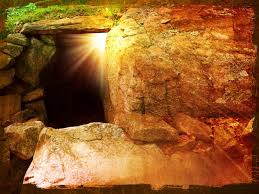
As sad as Good Friday was, the best news ever came on Sunday! The Tomb was empty!!! The birth of our Savior (Christmas), the death of our Savior (Good Friday), and the Resurrection of our now Risen Savior (Easter). The story of the human walk of Jesus is now complete with his impending Ascension soon at hand.
Blessings to all and a big thank you to those who followed the journey of Holy Week here with us.
Matthew 28:1-10
Jesus Has Risen
28 After the Sabbath, at dawn on the first day of the week, Mary Magdalene and the other Mary went to look at the tomb.
2 There was a violent earthquake, for an angel of the Lord came down from heaven and, going to the tomb, rolled back the stone and sat on it.3 His appearance was like lightning, and his clothes were white as snow.4 The guards were so afraid of him that they shook and became like dead men.
5 The angel said to the women, “Do not be afraid, for I know that you are looking for Jesus, who was crucified.6 He is not here; he has risen, just as he said. Come and see the place where he lay.7 Then go quickly and tell his disciples: ‘He has risen from the dead and is going ahead of you into Galilee. There you will see him.’ Now I have told you.”
8 So the women hurried away from the tomb, afraid yet filled with joy, and ran to tell his disciples.9 Suddenly Jesus met them. “Greetings,” he said. They came to him, clasped his feet and worshiped him.10 Then Jesus said to them, “Do not be afraid. Go and tell my brothers to go to Galilee; there they will see me.”
This is the day after the Crucifixion and the day before the Resurrection, as depicted by the featured photo. Saturday was the Jewish Sabbath, and little would have been done on this day. As you can read below in accounts from each of the Gospels, the Pharisees are worried about the body of Jesus being stolen. Pilate gave the order to have the tomb and it was secured by a guard and a seal was placed on the stone.
The body of our Savior was wrapped in linen along with spices and perfume, as was the Jewish burial custom of that period.
The sadness of the day before was very evident and they didn’t know the miracle that was to take place when “then came the morning”!
Matthew 27:62-66
The Guard at the Tomb
62 The next day, the one after Preparation Day, the chief priests and the Pharisees went to Pilate.63 “Sir,” they said, “we remember that while he was still alive that deceiver said, ‘After three days I will rise again.’64 So give the order for the tomb to be made secure until the third day. Otherwise, his disciples may come and steal the body and tell the people that he has been raised from the dead. This last deception will be worse than the first.”
65 “Take a guard,” Pilate answered. “Go, make the tomb as secure as you know how.”66 So they went and made the tomb secure by putting a seal on the stone and posting the guard.
Mark 16:1
Jesus Has Risen
16 When the Sabbath was over, Mary Magdalene, Mary the mother of James, and Salome bought spices so that they might go to anoint Jesus’ body.
Luke 23:56
56 Then they went home and prepared spices and perfumes. But they rested on the Sabbath in obedience to the commandment.
John 19:40
40 Taking Jesus’ body, the two of them wrapped it, with the spices, in strips of linen. This was in accordance with Jewish burial customs.
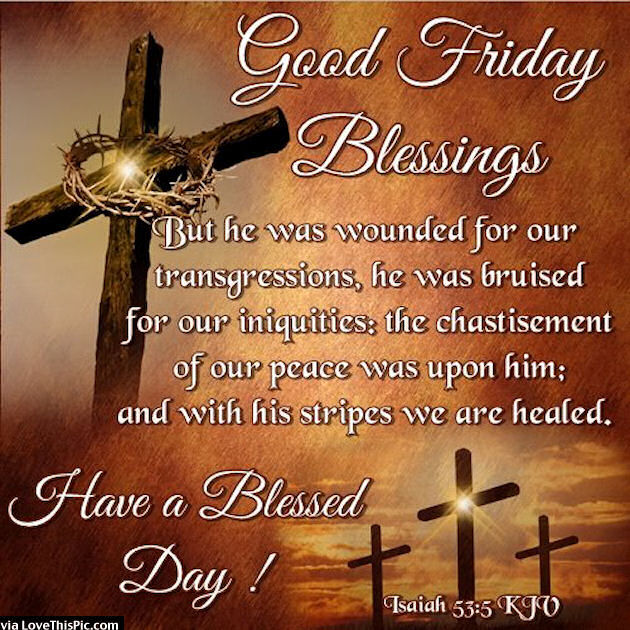
Trial, Crucifixion, Death, and Burial on Good Friday
Good Friday is the most difficult day of Passion Week. Christ’s journey turned treacherous and acutely painful in these final hours leading to his death.
According to Scripture, Judas Iscariot, the disciple who had betrayed Jesus, was overcome with remorse and hanged himself early Friday morning.
Meanwhile, before the third hour (9 a.m.), Jesus endured the shame of false accusations, condemnation, mockery, beatings, and abandonment. After multiple unlawful trials, he was sentenced to death by crucifixion, one of the most horrible and disgraceful methods of capital punishment known at the time.
Before Christ was led away, soldiers spit on him, tormented and mocked him, and pierced him with a crown of thorns. Then Jesus carried his own cross to Calvary where, again, he was mocked and insulted as Roman soldiers nailed him to the wooden cross.
Jesus spoke seven final statements from the cross. His first words were, “Father, forgive them, for they do not know what they are doing.” (Luke 23:34, NIV). His last words were, “Father, into your hands I commit my spirit.” (Luke 23:46, NIV)
Then, about the ninth hour (3 p.m.), Jesus breathed his last breath and died.
By 6 p.m. Friday evening, Nicodemus and Joseph of Arimathea took Jesus’ body down from the cross and lay it in a tomb.
Friday’s events are recorded in Matthew 27:1-62, Mark 15:1-47, Luke 22:63-23:56, and John 18:28-19:37.
From Bethany, Jesus sent Peter and John ahead to the Upper Room in Jerusalem to make the preparations for the Passover Feast. That evening after sunset, Jesus washed the feet of his disciples as they prepared to share in the Passover. By performing this humble act of service, Jesus demonstrated by example how believers should love one another. Today, many churches practice foot-washing ceremonies as a part of their Maundy Thursday services.
Then, Jesus shared the feast of Passover with his disciples, saying:
“I have been very eager to eat this Passover meal with you before my suffering begins. For I tell you now that I won’t eat this meal again until its meaning is fulfilled in the Kingdom of God.” (Luke 22:15-16, NLT)
As the Lamb of God, Jesus was about to fulfill the meaning of Passover by giving his body to be broken and his blood to be shed in sacrifice, freeing us from sin and death. During this Last Supper, Jesus established the Lord’s Supper, or Communion, instructing his followers to continually remember his sacrifice by sharing in the elements of bread and wine (Luke 22:19-20).
Later, Jesus and the disciples left the Upper Room and went to the Garden of Gethsemane, where Jesus prayed in agony to God the Father. Luke’s Gospel says that “his sweat became like great drops of blood falling down to the ground” (Luke 22:44, ESV).
Late that evening in Gethsemane, Jesus was betrayed with a kiss by Judas Iscariot and arrested by the Sanhedrin. He was taken to the home of Caiaphas, the High Priest, where the whole council had gathered to begin making their case against Jesus.
Meanwhile, in the early morning hours, as Jesus’ trial was getting underway, Peter denied knowing his Master three times before the rooster crowed.
Thursday’s events are recorded in Matthew 26:17–75, Mark 14:12-72, Luke 22:7-62, and John 13:1-38.
The Bible doesn’t say what the Lord did on the Wednesday of Passion Week. Scholars speculate that after two exhausting days in Jerusalem, Jesus and his disciples spent this day resting in Bethany in anticipation of Passover.
Just a short time previously, Jesus had revealed to the disciples, and the world, that he had power over death by raising Lazarus from the grave. After seeing this incredible miracle, many people in Bethany believed that Jesus was the Son of God and put their faith in him. Also in Bethany just a few nights earlier, Lazarus’ sister Mary had lovingly anointed the feet of Jesus with expensive perfume.
The significance of Holy Tuesday is not easily grasped. In a single day, Jesus would simultaneously condemn the religious authorities while confirming His deity. The cleansing of the Temple on Holy Monday caused the Pharisees to question Jesus’ right to do “these things.” Jesus had not received His authority from the religious leaders . . . so they wanted answers.
Attempts were made to force Jesus to state that He had divine power from God. Then He could be charged with blasphemy, even arrested. Knowing their motives, Jesus agreed to answer their questions if they first answered whether John the Baptist’s work was human or divine. If divine, John’s preaching affirmed Jesus as divine. If human, those who followed John would riot. It was the Sanhedrin’s responsibility to know the difference between true and false prophets, yet they shamefully admitted they didn’t know. Thus, Jesus did not answer their question (Matthew 21:23–27;Mark 11:27–33).
On Monday morning, Jesus returned with his disciples to Jerusalem. Along the way, he cursed a fig tree because it had failed to bear fruit. Some scholars believe this cursing of the fig tree represented God’s judgment on the spiritually dead religious leaders of Israel. Others believe the symbolism extended to all believers, demonstrating that genuine faith is more than just outward religiosity; true, living faith must bear spiritual fruit in a person’s life.
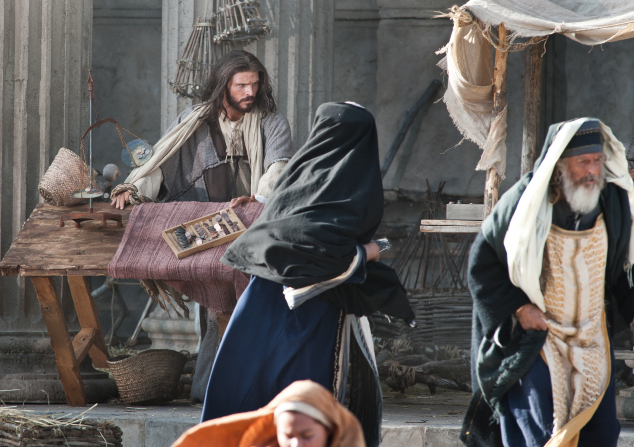
When Jesus arrived at the Temple, he found the courts full of corrupt money changers. He began overturning their tables and clearing the Temple, saying, “The Scriptures declare, ‘My Temple will be a house of prayer,’ but you have turned it into a den of thieves” (Luke 19:46).
On Monday evening Jesus stayed in Bethany again, probably in the home of his friends, Mary, Martha, and Lazarus.
Monday’s events are recorded in Matthew 21:12–22, Mark 11:15–19, Luke 19:45-48, and John 2:13-17.
5 Things about Palm Sunday that Remind Us Christ is King
1. God’s Word tells us the people cut palm branches and waved them in the air, laid them out on the ground before Jesus as He rode into the city. The palm branch represented goodness and victory and was symbolic of the final victory He would soon fulfill over death.
“O death, where is your victory? O death, where is your sting?” 1 Cor. 15:55
2. Jesus chose to ride in on a donkey, which directly fulfilled Old Testament prophecy of Zech. 9:9. In Biblical times, it was common for kings or important people to arrive by a procession riding on a donkey. The donkey symbolized peace, so those who chose to ride them showed that they came with peaceful intentions. Jesus even then reminded us that He is the Prince of Peace.
“Rejoice greatly, O daughter of Zion! Shout aloud, O daughter of Jerusalem! Behold, your king is coming to you; righteous and having salvation is he, humble and mounted on a donkey, on a colt, the foal of a donkey.” Zech. 9:9
3. When the people shouted “Hosanna!” they were hailing Christ as King. That word actually means “save now,” and though in their own minds they waited for an earthly king, God had a different way in mind of bringing true salvation to all who would trust in Him.
“Blessed is he who comes in the name of the LORD!” Ps. 118:26
“If you confess with your mouth that Jesus is Lord and believe in your heart that God raised him from the dead, you will be saved.” Rom. 10:9
4. The Bible says that Jesus wept for Jerusalem. In the midst of the praise of the moment, He knew in His heart that it wouldn’t be long that these same people would turn their backs on Him, betray Him, and crucify Him. His heart broke with the reality of how much they needed a Savior.
“As he approached Jerusalem and saw the city, he wept over it, and said, “If you, even you, had only known on this day what would bring you peace–but now it is hidden from your eyes.” Luke 19:41-42
5. Palm Sunday reminds us that the reign of Christ is far greater than any the mind of man could ever conceive or plan. Man looked for someone to fight their battles in the present day world. Yet God had the ultimate plan of sending His Son to fight the final battle over death. This is the greatness of why we celebrate this week. Because of Christ’s ultimate sacrifice, we can be set free of death.
“Jesus said to her, ‘I am the resurrection and the life; he who believes in Me will live even if he dies,'”John 11:25
We have so much to be grateful for this week.
The enemy knows that, and you can bet, he’s going to do everything he can to try and distract us away from the true meaning of what this Holy Week means. Don’t let him win.
In this Holy Week, may God direct our thoughts and attention towards what matters most, Jesus Christ our King…
Let’s choose to focus on worshipping our Lord, thanking Him for the gift of His sacrifice, celebrating the power of the Resurrection, and the new life found in Him alone.
Grace.
“Thanks be to God for His indescribable gift!” 2 Cor. 9:15
Jesus: His Life is an epic new drama-doc series revealing the enigmatic figure of Jesus as never before seen: through the eyes of the people closest to Him. Family, friends, followers, and those whose lives cross with his in dramatic ways, create a 360 portrait of Jesus – the man and the Messiah – from eight different and intimate perspectives: Joseph, John the Baptist, Mary, Caiaphas, Mary Magdalene, Peter, Pontius Pilate and Judas Iscariot.
HISTORY® TO PREMIERE EIGHT-PART EVENT
“JESUS: HIS LIFE” ON MONDAY, MARCH 25
Epic Retelling of the Life of Jesus Christ Airs Over Four Weeks Leading Up to Easter
New York, NY – January 18, 2019 – HISTORY’s eight-part event “Jesus: His Life” explores the story of Jesus Christ through a unique lens: the people in his life who were closest to him. Each of the eight chapters is told from the perspective of different biblical figures, all of whom played a pivotal role in Jesus’ life including Joseph, John the Baptist, Mary Mother of Jesus, Caiaphas, Judas Iscariot, Pontius Pilate, Mary Magdalene and Peter.
Each figure takes a turn guiding viewers through the emotional and epic story of the most famous man in history, through his birth, death and resurrection, all conveyed through a combination of scripted drama and interviews with prominent religious and historical experts. Utilizing some of the world’s most respected Biblical scholars, historians, faith leaders and theologians, the series weaves together the canonical Gospels, historical sources and cultural context to create a complete portrait of Jesus – the man and the Messiah. The series reveals his journey through a complex world of kings, politicians, reformers and soldiers in a turbulent power struggle during a time of revolutionary change. “Jesus: His Life” brings viewers into this dramatic world to reveal the greatest story ever told. The series premieres two episodes back-to-back weekly beginning on Monday, March 25 at 8pm ET/PT, with the finale airing just before Easter. A+E Networks holds exclusive worldwide distribution rights for the series which is produced by Nutopia.
“‘Jesus: His Life’ brings together some of the world’s top scholars, historians and faith leaders from diverse ideological and theological perspectives to tell the story of Jesus in a new way,” said Mary Donahue, SVP, Programming and Development for HISTORY. “Viewers will see and experience the life of Jesus as never before, through this powerful and thought-provoking portrait of a man who is one of the most influential people in human history.”
The series interviews and consulted with a diverse group of scholars, faith leaders and theologians from across the ideological spectrum to provide a rounded picture of the life and times in which Jesus lived, including:
Robert Cargill – Assistant Professor of Judaism, Christianity and Classics, University of Iowa
Christena Cleveland – Associate Professor, Duke University Divinity School
Bishop Michael Curry – Presiding Bishop and Primate of the Episcopal Church
Nicola Denzey Lewis – Professor in the Department of Religion, Claremont Graduate University
Joshua DuBois – Author and CEO, Values Partnerships and Head of White House Office of Faith-based and Neighborhood Partnerships under President Obama
Rabbi Joshua Garroway – Associate Professor of Early Christianity and the Second Commonwealth, Hebrew Union College
Mark Goodacre – Professor in the Department of Religious Studies, Duke University
Nyasha Junior – Associate Professor of Hebrew Bible, Temple University
Mark Leuchter – Professor and Director of Jewish Studies, Temple University
Kimberly Majeski – Associate Professor of Biblical Studies and Christian Ministries, Anderson University
Father James Martin, S.J – Jesuit Priest and Author
Ryan McAnnally-Linz – Associate Research Scholar, Yale Center for Faith and Culture
Scot McKnight – Professor of New Testament, Northern Seminary
Father Jonathan Morris – Catholic Priest
Candida Moss – Professor of Theology, University of Birmingham (UK)
Rev. Dr. Otis Moss III – Senior Pastor of Trinity United Church of Christ
Joel Osteen – Senior Pastor of Lakewood Church, New York Times Bestselling Author, and Executive Producer
Michael Peppard – Associate Professor in New Testament, Early Christian Studies, Religion and Public Life, Fordham University
Reverend Gabriel Salguero – Pastor and President of the National Latino Evangelical Coalition
Stephen Schneck – Associate Professor of Politics, Catholic University of America
Simon Sebag Montefiore – Historian and Author
Reverend Shively Smith – Assistant Professor of New Testament, Boston University School of Theology
Pastor Susan Sparks – Preacher, Comedian and Author
Miroslav Volf – Founder/Director, Yale Center for Faith and Culture and Professor of Theology, Yale University Divinity School
Ben Witherington III – Professor of New Testament for Doctoral Studies, Asbury Theological Seminary
Annette Yoshiko Reed – Associate Professor of Religious Studies, New York University
“Jesus: His Life” is produced for HISTORY by Nutopia with Jane Root and Ben Goold serving as executive producers. Eli Lehrer, Mary Donahue and Evan Lerner serve as executive producers for HISTORY. Joel Osteen also serves as Executive Producer. A+E Networks holds exclusive worldwide distribution rights for “Jesus: His Life.”
About HISTORY® HISTORY, a division of A+E Networks, is the premier destination for historical storytelling. From best-in-class documentary events, to a signature slate of industry leading nonfiction series and premium fact-based scripted programming, HISTORY serves as the most trustworthy source of informational entertainment in media. HISTORY has been named the #1 U.S. TV network in buzz for seven consecutive years by YouGov BrandIndex, and a top favorite TV network by Beta Research Corporation. For a deeper dive, visit history.com or follow @history on Instagram, Twitter and Facebook. For additional press materials visit the A+E Networks Press Center at http://press.aenetworks.com.
About Nutopia
Nutopia is a leading television production company based in LA, DC and London, creating innovative, award-winning, premium content on a global scale. Founded in 2008 by Jane Root, former President of Discovery Channel US, Controller of BBC2 and co-founder of Wall to Wall TV, Nutopia created the ‘mega doc’ model, blending huge scale history series and high-profile talent from the worlds of documentary and drama. Nutopia has become synonymous with creating high quality content that stands out from the crowd, working with some of the most prominent global broadcasters including Netflix, CNN, National Geographic, the BBC, PBS and A+E Networks. Most recently, Nutopia created National Geographic’s One Strange Rock which received three Wildscreen Festival Panda awards, was nominated for the Critics’ Choice Documentary awards and was shortlisted for the Grierson Best Science Documentary award. Other recent projects include Civilizations (BBC/PBS) and The Great American Read (PBS). Some critical successes for the company include the Emmy Award-winning series How We Got To Now; two seasons of ratings smash Finding Jesus. Faith. Fact. Forgery; Emmy Award-winning series America the Story of Us and Mankind the Story of All of Us.





 Pastor Ed Boston